Avalanche vs. Snowball: Which Debt Payoff Method Actually Gets You Out Faster?
A real month-by-month comparison — not just theory.
If you've got more than one credit card balance, you've probably run into the same question: pay off the card with the highest interest rate first, or knock out the smallest balance first for a quick win?
These are the two most common debt payoff strategies — the debt avalanche and the debt snowball — and people argue about which one is "right" as if there's a single correct answer. There isn't. There's a math answer and there's a psychology answer, and they don't always point the same direction. Let's look at both with real numbers.
The Two Methods, Quickly
Debt Avalanche — List your debts from highest interest rate to lowest. Pay minimums on everything, then throw every extra dollar at the highest-APR debt first. Once that's gone, roll its payment into the next-highest rate. Repeat.
Debt Snowball — List your debts from smallest balance to largest, regardless of interest rate. Pay minimums on everything, then throw every extra dollar at the smallest balance first. Once that's gone, roll its payment into the next one. Repeat.
Avalanche is built to minimize what you pay in interest. Snowball is built to give you a paid-off account as fast as possible, because crossing something off the list is what keeps most people going.
A Real Example
Say you're carrying three balances:
| Debt | Balance | APR | Minimum Payment |
|---|---|---|---|
| Store Card | $1,200 | 26% | $35 |
| Visa | $4,800 | 22% | $110 |
| Amex | $2,600 | 18% | $80 |
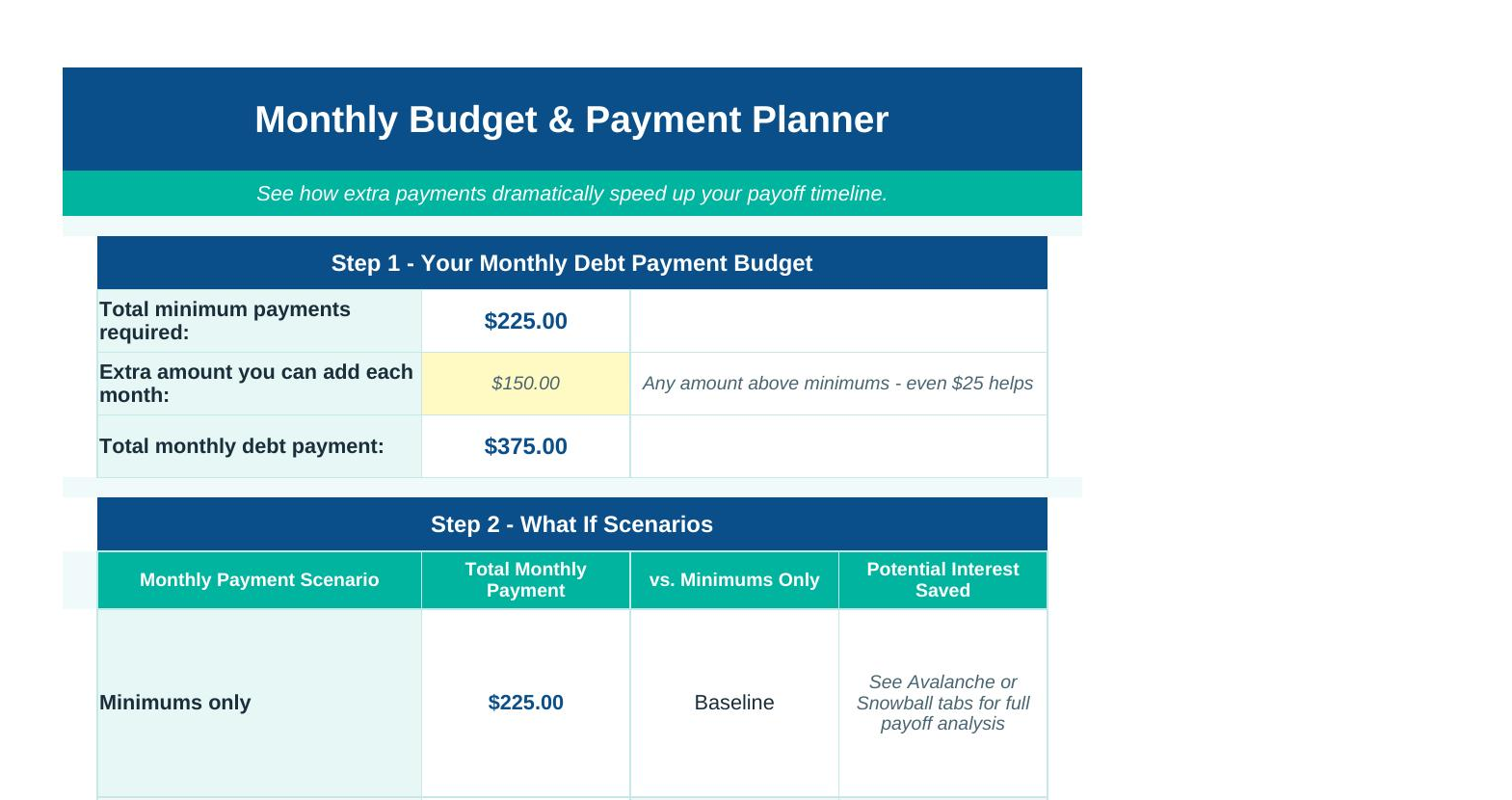
Your total minimum payments are $225/month, and you've found an extra $150/month to throw at this on top of that. Here's what actually happens under each method:
Avalanche order
Store Card → Visa → Amex
- Store Card paid off: month 8
- Visa paid off: month 26
- Amex paid off: month 30
Total interest: $2,433
Snowball order
Store Card → Amex → Visa
- Store Card paid off: month 8
- Amex paid off: month 17
- Visa paid off: month 30
Total interest: $2,536
Notice what's actually going on here. Both methods get you completely debt-free in the same month, month 30. Avalanche saves you about $103 in interest — that's the "math" answer, and it's a smaller gap than most people expect. When you pay the same total every month, the order mostly changes how much interest you pay, not when you finish. But look at the middle milestone: under snowball, you pay off your second account at month 17. Under avalanche, you don't get that second win until month 26 — nine months later. From month 17 to month 26, snowball has already closed a second account and has just one balance left open, while avalanche still has two open balances.
That's the real trade-off. It's not "smart vs. dumb," it's optimization vs. momentum. If you know you'll stay motivated without an early win, avalanche saves you real money. If you've stalled out on debt payoff before because it felt endless, that month-17 win might be the difference between finishing and quitting.
So Which One Should You Use?
A quick way to decide:
- Choose avalanche if: the interest rate gap between your debts is large (like the 26% vs 18% above), you don't have a history of losing motivation partway through, and you'd rather optimize for the lowest total cost.
- Choose snowball if: your balances vary a lot more than your rates do, you've tried debt payoff before and lost steam, or the psychological win of closing an account matters more to you right now than saving about a hundred dollars.
- Either way: the extra payment amount matters far more than which order you attack debts in. In the example above, paying only the minimums takes 66 months and about $6,121 in interest. An extra $150/month cuts that to 30 months — less than half the time. Where that money comes from will move the needle more than avalanche vs. snowball ever will.
Doing This By Hand Gets Old Fast
The math above took real amortization — interest accruing monthly, minimums still being paid on every open account, extra payments rolling over as each debt closes. Recalculating that by hand every time your balance changes, or every time you find an extra $50 in the budget, isn't realistic for most people.
That's exactly what the Debt Payoff Tracker is built to handle:
- Debt Summary — enter up to 20 debts once; it calculates per-card and overall credit utilization automatically
- Avalanche Payoff and Snowball Payoff tabs — both fully built out side by side, with the debt to attack first flagged automatically, so you can compare your own numbers instead of a generic example
- Monthly Budget — a what-if table showing exactly how much faster you'd finish with an extra $25, $50, $100, $200, or $500 a month, plus a 12-month progress tracker to actually follow along
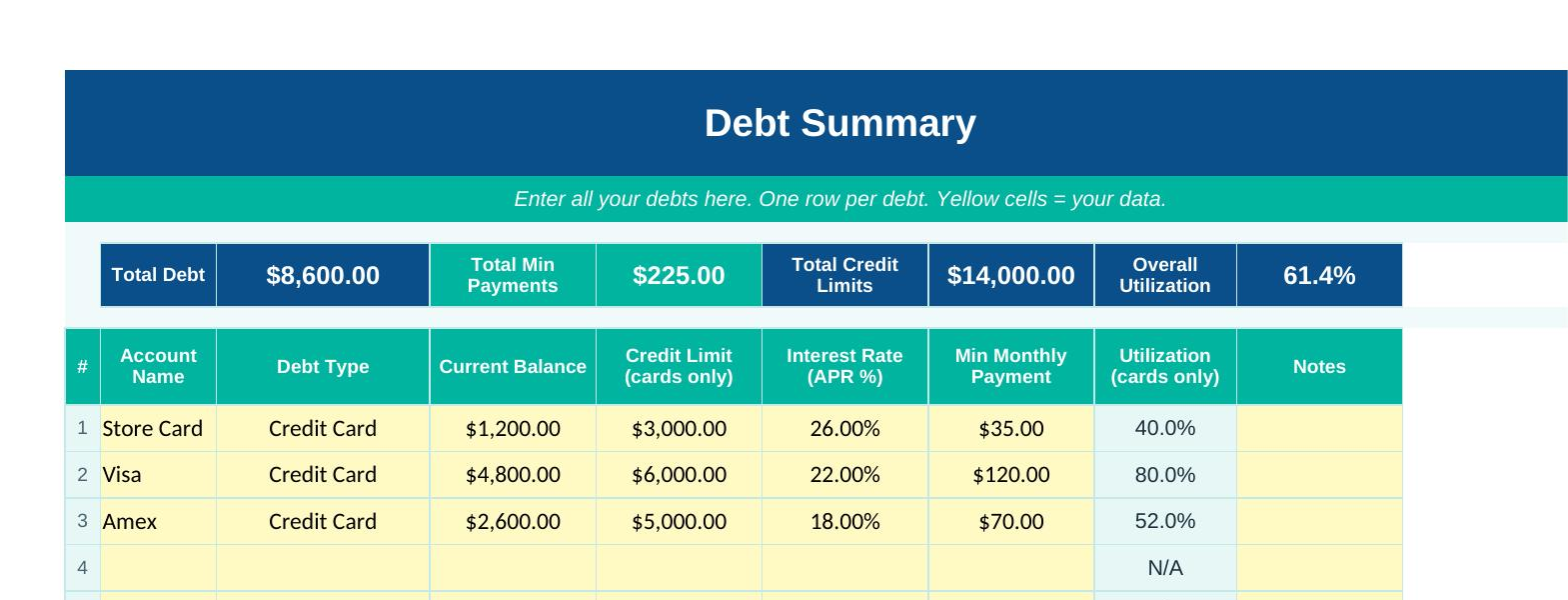
Plug in your own three, five, or ten debts and you'll see your actual avalanche vs. snowball numbers in a couple of minutes instead of redoing spreadsheet math every time something changes.
Already thinking about disputes or tracking your score too? The Complete Credit Health Bundle includes the Debt Payoff Tracker along with the Credit Score Planner and Dispute Tracker for $24.95 — less than buying all three separately.
Paying down balances also lowers your credit utilization — one of the five factors behind your score. New to how that all fits together? Start with Credit 101: The Complete Beginner's Guide. And if you're wondering how soon a lower balance actually shows up on your score, we cover that in How Long Does It Really Take to Rebuild Your Credit?.
Get more tips like this
No spam — just practical credit tips and new tools as they launch.
This article is for educational purposes and isn't financial or legal advice. Your actual payoff timeline depends on your real balances, rates, and payments, and can change if rates or minimums change.